Pending medical review by Dr. Ravinder Singh Rao. [Remove this note once approved.]
What Is TAVR/TAVI?
TAVR stands for transcatheter aortic valve replacement. It is also called TAVI, transcatheter aortic valve implantation. It replaces a narrowed aortic valve without opening the chest.
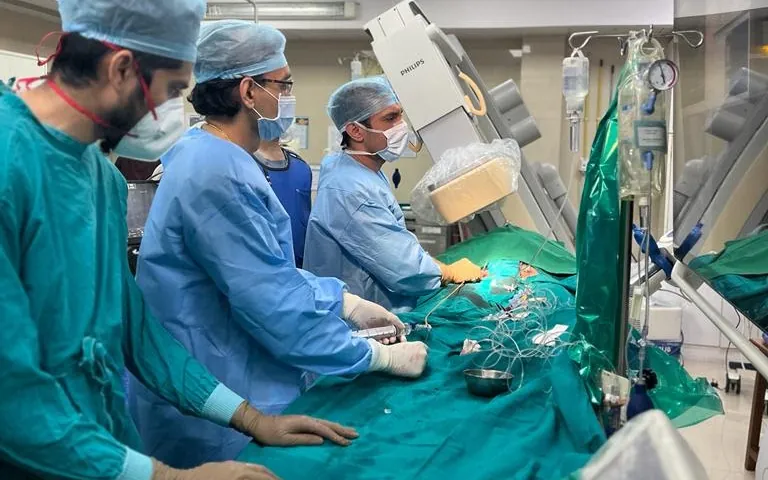
The aortic valve controls blood flow from the heart to the rest of the body. In TAVR, a new valve made of tissue on a metal frame is folded onto a thin, flexible tube called a catheter. The doctor guides the catheter through a blood vessel, most often in the groin, up to the heart. The new valve is then opened inside the old one, pushes the old valve flaps aside and starts working straight away.
What Is Aortic Stenosis?
Aortic stenosis means the aortic valve has become narrow and stiff, so it does not open fully. The heart has to work harder to push blood out to the body.
Read more: causes, signs and how it is diagnosed.
Who Is Eligible for TAVR?
TAVR is used for people with severe aortic stenosis. A heart team, including an interventional cardiologist and a cardiac surgeon, decides together whether TAVR, open-heart valve surgery or another treatment is best for you. They look at your symptoms, age, other health conditions, and the size and shape of your valve and blood vessels on a CT scan.
How Is the TAVR Procedure Performed?
- You will usually have sedation, or sometimes general anaesthesia
- The doctor makes a small puncture, most often in the groin
- The new valve is guided to the heart and opened inside the old valve
- The procedure often takes one to two hours, and your heart and blood pressure are watched throughout
Read more: before, during and after TAVR.
Benefits and Risks of TAVR
- The valve is reached through a blood vessel, usually in the groin, without opening the chest
- A heart-lung machine is not needed
- Often done with sedation and local anaesthetic
- The hospital stay is usually a few days
Every heart procedure carries some risk. With TAVR these can include bleeding or damage to the blood vessel used, stroke, a slow heart rhythm that needs a pacemaker, a small leak around the new valve and, rarely, more serious complications. Your doctor will talk you through your own risks before you decide.
TAVR vs Surgical Aortic Valve Replacement (SAVR)
SAVR (surgical aortic valve replacement) is open-heart surgery: the valve is replaced through an opening in the chest.
| TAVR | Open-heart valve surgery | |
|---|---|---|
| How the valve is reached | Through a blood vessel, usually in the groin | Through an opening in the chest |
| Heart-lung machine | Not needed | Usually needed |
| Anaesthesia | Often sedation with local anaesthetic | General anaesthesia |
| Hospital stay | Usually a few days | Usually a week or more |
| Back to daily activities | Often within days to a few weeks | Often several weeks to a few months |
Recovery After TAVR
- Take your medicines exactly as prescribed, including any blood thinners
- Increase your activity step by step, as advised
- Keep the puncture site clean and watch for swelling or bleeding
- Look after your teeth, and tell any dentist that you have a heart valve
- Carry the valve card you are given
- Go to every follow-up appointment and echocardiogram
Read more: recovery and when to get help.
Frequently Asked Questions About TAVR
Is TAVR open-heart surgery?
No. The new valve is put in through a blood vessel, usually in the groin, so the chest is not opened and a heart-lung machine is not needed.
Will I be awake during the procedure?
Many people have TAVR under sedation, so they are relaxed and comfortable but not fully asleep. Some people need general anaesthesia. Your team will tell you which is planned for you.
How long will I stay in hospital?
Many people go home within a few days. The exact time depends on your health and how the procedure goes.
Am I too old for TAVR?
Age alone does not rule TAVR out. Many people treated with TAVR are in their seventies, eighties or older. The heart team looks at your overall health, not just your age.
More answers: all frequently asked questions.
On this page
Talk to the team
Find out whether TAVR is an option for you or your family member.